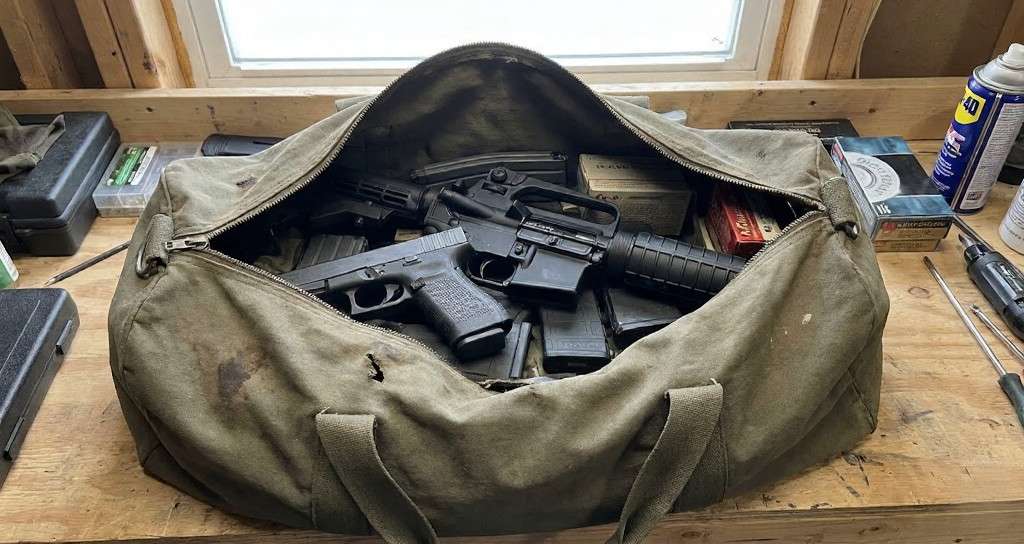
Charged with felon in possession of a firearm in Diamond Bar? You’re facing a straight felony with 16 months, 2 years, or 3 years in California state prison — no misdemeanor option, no probation guarantee, and prosecutors in Los Angeles County who treat these charges as a top enforcement priority. Whether the firearm was found in your vehicle during a traffic stop on the 57 or 60 freeway, discovered at your home during a search, or linked to you through an investigation, a PC § 29800 conviction brands you a convicted felon all over again — destroying employment prospects, forever stripping your right to bear arms, triggering immigration consequences, and potentially violating your existing probation or parole. This is not a charge you can afford to face without an aggressive, experienced, and bilingual criminal defense attorney who knows Diamond Bar, knows the Pomona Superior Court, and fights relentlessly for your rights and your future.
Accused of illegally possessing a firearm as a prohibited person in Diamond Bar or the surrounding communities of Walnut, Pomona, West Covina, or Rowland Heights? The stakes could not be higher — and every day without experienced legal representation is a day the prosecution uses to build a stronger case against you. At Tu Defensor Criminalista, we defend clients charged with felon in possession of a firearm throughout Los Angeles County, in English and in Spanish, with the tenacity, knowledge, and local expertise your case demands.
Free Confidential Consultation: (888) 315-3326 | Available 24/7 | Hablamos Español
Facing felon in possession charges in Diamond Bar? You’re not just fighting a new criminal case — you’re fighting to preserve what remains of your life, your family, your employment, and your freedom. California Penal Code § 29800[1] makes it a felony for any person who has been convicted of a felony under California law, any other state’s law, or federal law to own, possess, purchase, receive, or have under their custody or control any firearm. The same prohibition applies to persons convicted of certain misdemeanor domestic violence offenses, persons subject to active felony warrants, and persons addicted to narcotics.
According to the California Department of Justice, California leads the nation in firearm seizures and related enforcement actions[2], and Los Angeles County — where Diamond Bar is located — is the most populous county in the United States, making it the epicenter of California’s firearm enforcement activity. The Los Angeles County Sheriff’s Department (LASD)[3], which provides law enforcement services to Diamond Bar as a contract city, aggressively investigates and arrests individuals suspected of illegal firearm possession, and the Los Angeles County District Attorney’s Office[4] prosecutes PC § 29800 cases with severity.
Understanding what you’re truly facing — the charges, the evidence, the available defenses, and the potential outcomes — is the first and most critical step toward protecting yourself. Our attorneys provide that understanding from the first phone call, and we fight for the best possible result at every stage of your case.
Charged with PC § 29800 in Diamond Bar and unsure what it actually means? You’re facing a charge that the prosecution treats as straightforward — but which contains multiple legal elements that can be challenged, and multiple defenses that an experienced attorney can raise on your behalf.
California Penal Code § 29800[1] establishes the following categories of prohibited persons who may not possess firearms:
To secure a conviction for PC § 29800, the prosecution must prove all of the following beyond a reasonable doubt:
Each element of this charge is subject to challenge. Our attorneys scrutinize the evidence against each element to identify every available defense.
Diamond Bar is a residential city in eastern Los Angeles County, situated at the junction of the 57 and 60 freeways — one of the busiest freeway intersections in the entire Los Angeles basin. With a population of approximately 55,000 residents[7], Diamond Bar is a diverse community served by the Los Angeles County Sheriff’s Department’s Diamond Bar/Walnut Station. The freeway corridors that define Diamond Bar’s geography make it a high-volume law enforcement stop zone — and vehicle stops along the 57 and 60 freeways regularly produce firearm discoveries that lead to PC § 29800 charges.
Los Angeles County consistently ranks among the highest counties in California for weapon-related arrests and prosecutions, according to the California Department of Justice Criminal Justice Statistics Center[8]. The sheer volume of law enforcement activity in Los Angeles County — combined with the LASD’s focused enforcement on prohibited-person firearm possession — creates a challenging environment for anyone charged with PC § 29800 in Diamond Bar or the surrounding communities.
Diamond Bar criminal cases are prosecuted at the Pomona Superior Court[9], one of the busiest criminal courthouses in all of Los Angeles County. The Pomona Courthouse serves the eastern San Gabriel Valley, including Diamond Bar, Walnut, Pomona, La Verne, San Dimas, and surrounding communities. Knowledge of the Pomona Superior Court — its prosecutors, its judges, and its procedural culture — is essential to effective defense of PC § 29800 charges in Diamond Bar. Our attorneys appear regularly at the Pomona Courthouse and bring deep familiarity with this court to every case we handle.
The California Department of Justice’s Armed Prohibited Persons System (APPS)[10] cross-references Californians who have legally purchased or registered firearms with individuals who have subsequently become prohibited from possessing them due to criminal convictions, mental health adjudications, domestic violence restraining orders, and other disqualifying events. APPS-driven investigations and seizures are common throughout Los Angeles County — and many Diamond Bar residents first learn of their prohibited status when law enforcement arrives to seize their firearms or execute an arrest warrant.
Felon in possession charges in Diamond Bar typically arise in one of several common scenarios. Understanding how these charges develop helps you understand the evidence the prosecution relies on — and where defenses exist.
Many felon in possession cases in Diamond Bar can be successfully challenged on constitutional grounds. The Fourth Amendment to the United States Constitution and Article I, Section 13 of the California Constitution guarantee your right to be free from unreasonable searches and seizures. When law enforcement violates these rights, the evidence they obtain — including any firearm — can be suppressed, potentially resulting in case dismissal.
If the traffic stop that led to the firearm’s discovery was conducted without reasonable suspicion, the stop itself is unconstitutional, and all evidence obtained as a result — including the firearm — must be suppressed. This is one of the most powerful defenses available in felon in possession cases arising from vehicle stops along Diamond Bar’s freeway corridors.
Common bases for suppression include: a stop based solely on the driver’s race or appearance; a stop where the claimed traffic violation did not actually occur or was pretextual; a stop extending beyond its lawful scope without independent justification; or a stop conducted without reasonable articulable suspicion of criminal activity.
Even when a stop or initial contact is lawful, the subsequent search may not be. Law enforcement cannot search your vehicle without a warrant, your consent, probable cause to believe the vehicle contains contraband or evidence of a crime, or another recognized exception to the warrant requirement. When the search that discovered the firearm exceeded its lawful scope, the weapon can be suppressed.
For residential searches, the Fourth Amendment requires either a valid warrant supported by probable cause or a recognized exception. Challenges to the sufficiency of warrant affidavits — establishing that the affidavit contained misrepresentations, relied on stale information, or failed to establish probable cause — can invalidate a search warrant and lead to suppression of all evidence seized pursuant to it.
“Possession” under PC § 29800 includes both actual possession — the firearm is on your person — and constructive possession — the firearm is somewhere you have dominion and control over, such as your vehicle or home. When a firearm is found in a shared space, prosecutors often charge everyone associated with that space with possession. Challenging constructive possession by establishing that you lacked knowledge of the firearm’s presence or lacked dominion and control over it is a significant and frequently viable defense.
This defense is especially powerful in cases involving shared vehicles, shared residences with multiple occupants, or situations where the firearm was found in an area accessible to multiple people.
The prosecution must prove you knew the firearm was in your possession or custody. If you genuinely did not know a firearm was present — for example, if someone left a firearm in your vehicle without your knowledge — you cannot be convicted of PC § 29800. This defense requires careful development of the facts and circumstances, including witness statements, cell phone records, and other evidence that corroborates your lack of knowledge.
If law enforcement questioned you about the firearm without first advising you of your Miranda rights — or after you invoked your right to remain silent or your right to counsel — statements you made may be suppressed. Suppressing incriminating statements can significantly weaken or eliminate the prosecution’s case, particularly when your own admissions are the primary evidence of knowledge or possession.
In some cases, challenges to the chain of custody of the firearm — raising questions about how it was handled, transported, stored, and tested — can create reasonable doubt about whether the weapon offered in evidence is actually the weapon recovered from your case. These challenges are especially relevant in cases where law enforcement procedures were not properly followed.
A PC § 29800 charge requires the prosecution to prove you have a qualifying prior conviction. In some cases, prior convictions can be challenged — particularly when the prior conviction was unconstitutionally obtained (for example, without proper advisement of rights) or when the out-of-state conviction at issue does not legally qualify as a felony under California law.
Felon in possession of a firearm under California Penal Code § 29800[1] is a straight felony — it cannot be charged as a misdemeanor. Conviction carries:
Diamond Bar residents charged with felon in possession of a firearm may face not only state charges under PC § 29800 but also federal prosecution under 18 U.S.C. § 922(g)[14]. Federal felon in possession charges are aggressively pursued by the Bureau of Alcohol, Tobacco, Firearms and Explosives (ATF)[16] and the United States Attorney’s Office for the Central District of California, which covers Los Angeles County.
Federal felon in possession convictions under 18 U.S.C. § 922(g) carry penalties of up to 10 years in federal prison — and up to 15 years for individuals with three or more prior convictions for violent felonies or serious drug offenses under the Armed Career Criminal Act (ACCA), 18 U.S.C. § 924(e)[17]. Federal prison sentences are served without the possibility of parole, making federal prosecution far more serious in terms of actual time served than equivalent state charges.
When a felon in possession case in Diamond Bar involves federal jurisdiction — such as when the firearm traveled in interstate commerce, when the case involves other federal offenses, or when federal agencies participated in the arrest — our attorneys are equipped to coordinate defense at both the state and federal level.
Not every PC § 29800 case results in prison. Skilled defense attorneys explore every available path to minimize consequences and protect their clients’ futures.
Charged with felon in possession in Diamond Bar? Understanding what happens at each stage of the criminal process empowers you to make informed decisions and avoid costly mistakes that could hurt your case.
Throughout every stage of this process, Tu Defensor Criminalista stands with you — advising you, advocating for you, and fighting for the best possible outcome at every turn.
At Tu Defensor Criminalista, we approach every felon in possession case in Diamond Bar with the same philosophy: fight every element, challenge every constitutional violation, and pursue every avenue that gives our client the best possible outcome.
Felon in possession charges frequently arise alongside or in connection with other criminal matters. Our Diamond Bar criminal defense practice handles the full range of related offenses:
Our Los Angeles County felon in possession defense practice serves clients across the eastern San Gabriel Valley and beyond:
We appear regularly at the Pomona Superior Court[9], the East Los Angeles Courthouse, the Alhambra Courthouse, and the Clara Shortridge Foltz Criminal Justice Center in downtown Los Angeles.
Understanding the scope of felon in possession enforcement in California and Los Angeles County demonstrates why skilled, aggressive defense representation is non-negotiable:
The California Department of Justice reports that weapon-related felony arrests in Los Angeles County number in the thousands annually[8], with felon in possession charges representing a substantial proportion of those arrests. The concentration of prior felons, the volume of vehicle traffic along major freeway corridors, and the aggressive enforcement posture of LASD and CHP make Los Angeles County one of the most challenging jurisdictions in the nation for persons with prior convictions who inadvertently — or deliberately — come into contact with firearms.
The Bureau of Justice Statistics has documented that weapon offense conviction rates in California are among the highest in the nation[21], underscoring the importance of raising every available defense in PC § 29800 cases. Without skilled legal representation, the statistical likelihood of conviction is high.
The Bureau of Alcohol, Tobacco, Firearms and Explosives publishes annual data on federal firearm prosecutions[16] — and the Central District of California, which covers Los Angeles County, is consistently among the busiest federal districts for felon in possession prosecutions. Diamond Bar defendants can face both state and federal charges for the same firearm possession, making dual-jurisdiction awareness a critical component of effective defense.
California’s Armed Prohibited Persons System has resulted in thousands of enforcement contacts and weapon seizures throughout the state[10], with Los Angeles County representing a disproportionate share of these actions due to its population size and the volume of prior felony convictions in the county’s population.
California Penal Code § 29800 is a straight felony carrying 16 months, 2 years, or 3 years in state prison. The sentence imposed depends on your prior criminal record, the circumstances of the offense, and how aggressively your attorney advocates for you at sentencing. If you have prior serious or violent felony convictions, Three Strikes sentencing can dramatically increase your exposure.
Yes. The most common path to dismissal is a successful motion to suppress evidence — particularly where the firearm was discovered during an unlawful traffic stop or search. If the firearm is suppressed, the prosecution typically cannot proceed, and the case is dismissed. Our attorneys evaluate every PC § 29800 case for suppression possibilities from the first consultation.
No. A California expungement under PC § 1203.4 removes the conviction from your public record for most employment and licensing purposes, but it does not restore your right to possess firearms under California or federal law. Firearm rights restoration requires a separate legal process and is subject to strict eligibility requirements.
Yes — if the prosecution can establish “constructive possession,” meaning you had knowledge of the firearm and dominion or control over the area where it was found. However, constructive possession is a legal theory that can be challenged, particularly in shared vehicle or shared residence scenarios where the firearm could have belonged to another occupant.
Federal prosecution under 18 U.S.C. § 922(g) is possible in addition to or instead of state prosecution. Federal felon in possession convictions can result in up to 10 years in federal prison — served without parole. Whether your case is pursued federally depends on which agencies were involved in your arrest and the nature of the underlying facts. Our attorneys evaluate federal exposure in every PC § 29800 case.
For non-citizens, a PC § 29800 conviction is extremely serious. It can qualify as an aggravated felony or a crime involving moral turpitude under the Immigration and Nationality Act, triggering mandatory deportation proceedings, bars to re-entry, and permanent inadmissibility. Immigration consequences must be carefully evaluated as part of your overall defense strategy — and our attorneys do exactly that for every non-citizen client.
A PC § 29800 arrest while on probation typically triggers probation violation proceedings in addition to the new criminal case. You can face immediate custody, revocation of probation, and imposition of previously suspended sentences — all while defending against the new weapon charge. Simultaneous, coordinated defense of both matters is essential.
Felony probation is possible in PC § 29800 cases, though it is not guaranteed. Eligibility depends on your prior record, the specific circumstances of your case, and how effectively your attorney advocates for probation. For first-time PC § 29800 defendants with minimal criminal history, probation is a realistic and achievable goal with the right representation.
APPS is a California DOJ database that cross-references registered firearm owners with individuals who have subsequently become legally prohibited from possessing firearms. If you previously purchased firearms legally but later became a prohibited person, APPS may flag you for enforcement contact — typically a visit from law enforcement to seize your firearms and, if you fail to surrender them voluntarily, arrest you for PC § 29800.
A PC § 29800 conviction is itself a felony, and if your prior conviction(s) included a serious or violent felony, you may be sentenced as a second or third striker — doubling your sentence or triggering a 25-years-to-life term. Additionally, certain companion charges that may be filed alongside PC § 29800 can themselves be serious or violent felonies. Determining your Three Strikes exposure requires careful analysis of your complete criminal history.
Remember:
Attorney Armando Josué Cespedes is rated 5.0 on Avvo, with 34 five-star reviews from clients praising his dedication, professionalism, and results. Many note how his trial skills and attention to detail led to reduced charges or outright dismissals.



 English English
 Español de México English English Español de México
Thank you! We need your help. Would you share your experience on one of these sites?
If you have concerns you wish to address privately
