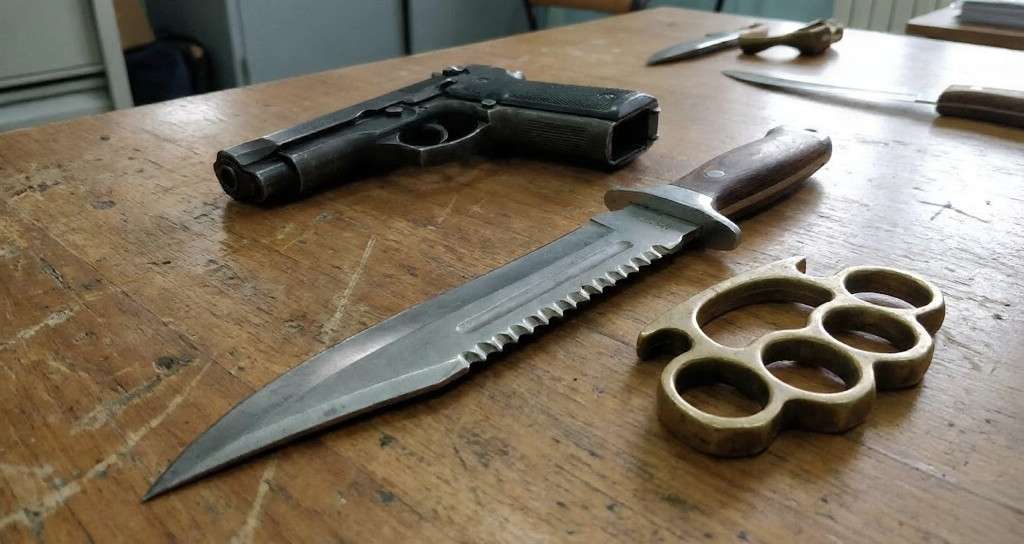
Charged with a weapon crime in Los Angeles County? You’re facing criminal penalties that range from misdemeanor probation to felony state prison — with STRIKE allegations, permanent criminal records, firearm prohibitions, immigration consequences, and the loss of professional licenses that can destroy the future you’ve worked to build. Whether accused of carrying a concealed dirk or dagger, possessing brass knuckles, brandishing a weapon, possession of a switchblade, possession of a billy club or baton, assault with a deadly weapon, or any other weapons offense, weapon crime convictions in Los Angeles County are prosecuted aggressively — and the consequences are permanent. You need an experienced Los Angeles weapon crimes defense attorney fighting for your rights immediately.
Accused of a weapon offense in Los Angeles County? You’re facing one of California’s most complex categories of criminal law — a web of statutes covering dozens of different prohibited weapons, varying penalties depending on the weapon type and circumstances, and overlapping enhancements that can transform a misdemeanor into a strike felony. The Los Angeles County District Attorney’s Office[1] prosecutes weapon crimes across 88 cities with the same seriousness as violent offenses — because in California, merely possessing certain weapons is a crime, regardless of intent. Whether this is your first arrest or you’re facing enhanced charges based on your history, Tu Defensor Criminalista provides aggressive, knowledgeable weapon crimes defense across every jurisdiction in Los Angeles County.
Free Confidential Consultation: (888) 315-3326 | Available 24/7 | Hablamos Español
California has some of the most expansive weapon prohibition laws in the United States — going far beyond firearms to encompass a wide range of edged weapons, impact weapons, electronic weapons, and martial arts instruments. The California Penal Code[2] dedicates an entire division — Division 10 of Title 4 — to the control and regulation of deadly and prohibited weapons, spanning Penal Code §§ 16000 through 34370.
In Los Angeles County — the most populous county in the nation, home to over 10 million residents across 88 incorporated cities — weapon crimes are enforced with exceptional vigor by the Los Angeles Police Department[3], the Los Angeles County Sheriff’s Department[4], and dozens of independent municipal police departments. According to the California Department of Justice — Criminal Justice Statistics Center[5], weapons offenses represent thousands of arrests statewide each year — and Los Angeles County consistently accounts for a disproportionate share of those prosecutions.
Understanding the specific weapon involved, the circumstances of your arrest, and the full range of charges and enhancements you face is the foundation of an effective defense strategy. Here is a comprehensive breakdown of weapon crimes commonly prosecuted in Los Angeles County.
Charged with carrying a concealed dirk or dagger in Los Angeles County? You’re facing a felony offense that carries 16 months, 2 years, or 3 years in state prison — and a permanent felony record that will follow you for life. Under California Penal Code § 21310[6], it is a felony to carry concealed on your person any dirk or dagger — defined as any knife or instrument capable of ready use as a stabbing weapon that may inflict great bodily injury or death. This charge is often filed after a traffic stop, a pat-down search, or a stop-and-frisk — and the legality of the stop and search is immediately at issue.
Under Penal Code § 21510[7], it is illegal to possess, carry in a vehicle, sell, offer for sale, expose for sale, loan, transfer, or give to any other person a switchblade knife with a blade of two or more inches. Violation is a misdemeanor, but when combined with gang enhancement allegations or prior weapon convictions, the consequences escalate significantly.
Accused of possessing brass knuckles in Los Angeles County? You’re facing a wobbler — a charge that can be prosecuted as either a misdemeanor or a felony under Penal Code § 21810[8]. Brass knuckles — also known as metal knuckles — are among the most commonly seized prohibited weapons in Los Angeles County. As a felony, the charge carries 16 months, 2 years, or 3 years in state prison. Prosecutors in Los Angeles routinely file felony charges for brass knuckles possessions involving individuals with prior records or when gang enhancement allegations are added.
Under Penal Code § 22210[9], possession of a leaded cane, billy, blackjack, sandbag, sandclub, sap, or slungshot is a wobbler offense. This statute is broadly applied in Los Angeles County, and what constitutes a “billy” or impact weapon under the law is frequently a point of contention. We aggressively challenge both the identification of the object as a prohibited weapon and the circumstances of possession.
Penal Code § 22010[10] prohibits the manufacture, import, sale, supply, transportation, distribution, or possession of nunchaku — also known as nunchucks. While primarily associated with martial arts training, possession outside of established training facilities is illegal in California. This is a wobbler that can be charged as a misdemeanor or felony.
California law under Penal Code § 22610[11] generally permits adults without felony convictions to purchase and possess stun guns and tasers. However, possession by convicted felons, those convicted of assault or battery, persons addicted to narcotics, and minors is a misdemeanor offense. In Los Angeles County, taser and stun gun charges frequently arise alongside other criminal allegations.
Under Penal Code § 33215[12], possession of short-barreled rifles and shotguns — including sawed-off shotguns — is a wobbler offense carrying up to 3 years in state prison as a felony. These charges often involve disputed questions about barrel length measurements and whether the weapon actually meets the statutory definition of a prohibited short-barreled weapon.
Charged with assault with a deadly weapon in Los Angeles County? You’re facing one of the most serious assault charges in California — a STRIKE offense that can result in years in state prison and a permanent felony record. Under Penal Code § 245(a)(1)[13], a “deadly weapon” is not limited to firearms — it includes knives, bats, bottles, tools, vehicles, and any object used in a manner capable of producing death or great bodily injury. As a felony, ADW carries 2, 3, or 4 years in state prison and counts as a serious felony strike under Penal Code § 667[14] under California’s Three Strikes Law.
Under Penal Code § 417[15], drawing or exhibiting any deadly weapon — firearm or otherwise — in a rude, angry, or threatening manner in the presence of another person, or using any deadly weapon in a fight, is a criminal offense. Brandishing is typically a misdemeanor but escalates to a felony when committed in the presence of a peace officer or when the weapon is a firearm. In Los Angeles County, brandishing charges frequently arise from road rage incidents, neighborhood disputes, and domestic altercations.
California law under Penal Code § 33600[16] prohibits the manufacture, import, sale, supply, or possession of a zip gun — any weapon made or altered to expel a projectile by the force of an explosion or other form of combustion, which is not a firearm within the definition of federal law. Zip gun charges are wobblers prosecuted as misdemeanors or felonies depending on the circumstances.
Penal Code § 22000[17] prohibits the manufacture, importation, sale, offer for sale, or possession of any caltrop — a multi-pronged metal object designed to be scattered on the ground to puncture tires or injure persons. While less commonly prosecuted, this charge illustrates the breadth of California’s prohibited weapons statutes.
California generally permits adults to carry tear gas and pepper spray for self-defense under Penal Code § 22810[18], subject to size and age restrictions. However, possession by felons, certain misdemeanants, and minors is prohibited and can result in criminal charges. In Los Angeles County, tear gas charges are often filed alongside other criminal allegations arising from the same incident.
Weapon charges in Los Angeles County are frequently coupled with gang enhancement allegations under Penal Code § 186.22[19], which can dramatically increase sentencing exposure. The gang enhancement requires proof that the crime was committed for the benefit of, at the direction of, or in association with a criminal street gang. We aggressively challenge gang enhancement allegations by scrutinizing the prosecution’s gang expert testimony, the sufficiency of the gang nexus evidence, and the classification of the accused as a gang member or associate.
Los Angeles County is the most populous county in the United States, with over 10 million residents. According to the California Department of Justice — Criminal Justice Statistics Center[5], weapons offenses account for thousands of criminal arrests in Los Angeles County each year — making it one of the highest-volume weapon crime prosecution jurisdictions in the nation.
The Los Angeles Police Department’s CompStat reporting[20] reflects the volume of weapons-related arrests across LAPD divisions — before accounting for the Los Angeles County Sheriff’s Department[4] and the dozens of independent city police departments operating throughout the county. According to the California Attorney General’s annual crime report[5], weapons offenses in Los Angeles County span everything from knife possession and prohibited weapon carrying to felony assault with deadly weapons — with thousands of cases filed in Los Angeles County courts each year.
The Los Angeles County District Attorney’s Office[1] — one of the largest prosecutorial offices in the world — processes hundreds of thousands of criminal filings annually, and weapon crimes are among the categories pursued with consistent seriousness regardless of the specific weapon involved or the defendant’s prior record.
The consequences of a weapon crime conviction in Los Angeles County extend far beyond the courthouse. In one of the nation’s most competitive regions for employment, housing, and professional licensing, a criminal record for a weapon offense can permanently alter every aspect of your future.
At Tu Defensor Criminalista, our weapon crimes defense attorneys build every defense strategy from the ground up — analyzing the specific weapon charged, the circumstances of the stop and search, the prosecution’s evidence, and every available legal challenge to craft the strongest possible defense for your unique situation.
The most powerful defense in many weapon crime cases is a challenge to the legality of the search that discovered the weapon. Under the Fourth Amendment to the U.S. Constitution[26] and California’s independent privacy protections under A[27]rticle I, Section 13 of the California Constitution[27], law enforcement must have lawful authority to search your person, vehicle, or home. If the weapon was found through an unlawful traffic stop, an unjustified pat-down, an illegal vehicle search, or coerced consent, we file a motion to suppress the evidence under Penal Code § 1538.5[28]. A successful suppression motion frequently results in complete dismissal of all charges.
Many weapon crime statutes in California contain specific technical definitions of the prohibited object. Whether a knife constitutes a “dirk or dagger” under PC § 21310, whether a folding knife is a “switchblade” under PC § 21510, or whether an object qualifies as a “billy” under PC § 22210 often depends on detailed factual and legal analysis. We challenge the prosecution’s characterization of the object and argue that the item does not meet the statutory definition of a prohibited weapon.
California’s prohibited weapon statutes require proof that you knew you possessed the weapon. If the weapon was in a shared vehicle or property, or if you were unaware the object was present, a lack of knowledge defense may be available. Proving that you did not know the item was there — or did not know it was a prohibited weapon — can defeat the prosecution’s case.
Many weapon laws contain specific exemptions for law enforcement officers, military personnel, hunters, collectors, entertainers, and others. We investigate whether any statutory exemption applies to your specific situation and present that defense aggressively to prosecutors and courts.
California courts recognize a defense of momentary or innocent possession in limited circumstances — where a person briefly possesses a prohibited weapon for the sole purpose of safely disposing of it, with no intent to use it unlawfully or keep it. Where the facts support this defense, we present it carefully with supporting evidence.
Gang enhancements under PC § 186.22 require specific proof of gang membership, gang purpose, and gang benefit. We scrutinize the prosecution’s gang expert testimony, challenge the reliability and methodology of gang classification, and attack the evidence linking the weapon offense to gang activity. Defeating a gang enhancement can dramatically reduce sentencing exposure — sometimes by years or decades.
Where a weapon was used or carried in response to an actual or imminent threat, self-defense and defense of others under Penal Code § 197[29] and California’s CALCRIM jury instructions may provide a complete defense to assault with a deadly weapon and related charges. We investigate the circumstances of the alleged offense thoroughly to build compelling self-defense arguments where the facts support them.
The prosecution bears the burden of proving every element of every weapon charge beyond a reasonable doubt. We scrutinize every piece of evidence — police reports, body camera footage, crime lab reports, witness statements, and physical evidence — to identify gaps, inconsistencies, and weaknesses that undermine the prosecution’s ability to meet its burden.
When you’re facing weapon charges in Los Angeles County, you need more than a lawyer — you need a dedicated criminal defense advocate who knows the local courts, understands the full complexity of California’s weapon laws, and has the experience and commitment to fight aggressively at every stage of your case.
Serving Every City in Los Angeles County — Local Knowledge That Matters
Los Angeles County spans 4,751 square miles and encompasses 88 incorporated cities plus numerous unincorporated communities. Weapon crime charges in different cities are handled by different law enforcement agencies and prosecuted through different courts. Our local knowledge across every jurisdiction gives our clients a genuine strategic advantage at every stage of their case.
We represent clients charged with weapon crimes in: Los Angeles, Long Beach, Glendale, Santa Clarita, Lancaster, Palmdale, Pomona, Torrance, Pasadena, El Monte, Downey, Inglewood, West Covina, Norwalk, Burbank, Compton, South Gate, Carson, Santa Monica, Hawthorne, Whittier, Alhambra, Lakewood, Bellflower, Baldwin Park, Lynwood, Redondo Beach, Paramount, Pico Rivera, Montebello, Monrovia, Gardena, Culver City, Arcadia, Diamond Bar, Covina, Azusa, Beverly Hills, San Gabriel, West Hollywood, Manhattan Beach, Bell Gardens, Bell, Huntington Park, Maywood, South El Monte, El Segundo, Lawndale, Lomita, Rolling Hills Estates, Palos Verdes Estates, Rancho Palos Verdes, Signal Hill, La Mirada, Cerritos, Artesia, Hawaiian Gardens, Cudahy, Vernon, Commerce, Industry, San Fernando, Calabasas, Hidden Hills, Agoura Hills, Westlake Village, La Cañada Flintridge, Sierra Madre, Temple City, San Marino, Rosemead, Monterey Park, Duarte, Irwindale, Bradbury, Glendora, Claremont, San Dimas, La Verne, and all unincorporated areas throughout Los Angeles County.
A significant percentage of weapon crime arrests in Los Angeles County arise from traffic stops — where an officer discovers a prohibited weapon during a vehicle search or pat-down. The legality of both the stop and the search are immediately in question. Was there lawful justification for the traffic stop? Did the officer have legal authority to search the vehicle or your person? Were you coerced into consenting? These are the questions our attorneys ask from the moment you call us.
Police in Los Angeles County frequently conduct pedestrian stops based on alleged reasonable suspicion of criminal activity — and many weapon arrests result from pat-down searches conducted during those stops. Whether the stop was justified, whether the officer had proper grounds to conduct the pat-down, and whether the item seized actually constitutes a prohibited weapon are all critical questions we investigate immediately.
Police responding to domestic violence calls frequently search homes for weapons. When a prohibited weapon is discovered during a domestic call, the person may face both domestic violence and weapons charges simultaneously. We defend both sets of charges — examining whether the warrantless home search was constitutionally justified, whether the weapon belonged to the accused, and whether the domestic allegation was accurate.
Los Angeles County’s notorious traffic congestion generates a high volume of road rage incidents — many of which lead to brandishing charges and assault with a deadly weapon allegations. When a vehicle, bat, tool, or other object is alleged to have been used as a weapon during a traffic confrontation, weapon charges can follow. We investigate witness accounts, surveillance footage, and the full factual circumstances of every road rage weapon case.
Los Angeles County has a significant presence of criminal street gangs, and weapon charges arising in gang contexts are frequently enhanced with gang allegations under PC § 186.22. These enhancements are serious and can dramatically increase sentencing — but they also require specific proof that is often challengeable. We provide aggressive defense against both the underlying weapon charge and any gang enhancement allegations.
Many weapon crime arrests in Los Angeles County arise from incidents where the accused was acting in genuine self-defense. People who carry knives, clubs, or other objects for protection — and use or brandish them when actually threatened — are sometimes arrested despite the legitimacy of their self-defense actions. We investigate the full circumstances of every alleged incident to present compelling self-defense arguments where the facts support them.
With approximately 35% of residents foreign-born according to the U.S. Census Bureau[24], Los Angeles County has one of the largest immigrant populations in the world. For non-U.S. citizens, weapon crime convictions — particularly felonies involving violence or assault with a deadly weapon — carry catastrophic immigration consequences, including mandatory deportation, permanent inadmissibility, and destruction of naturalization eligibility.
Assault with a deadly weapon and other violent weapon offenses are frequently classified as crimes of moral turpitude or aggravated felonies under federal immigration law, triggering mandatory removal from the United States regardless of how long you have lived here, your family ties, or your contributions to your community. Even misdemeanor weapon convictions can have immigration consequences depending on the specific charge and the disposition.
At Tu Defensor Criminalista, our attorneys are deeply versed in the intersection of California criminal law and federal immigration law. We evaluate every plea and disposition through an immigration lens — working to protect your ability to remain in the United States while aggressively defending the underlying criminal charges.
If you or a loved one has been arrested for or charged with any weapon crime anywhere in Los Angeles County, do not wait. Every hour without experienced legal representation can hurt your case. Contact Tu Defensor Criminalista today for a free, confidential consultation.
Website:tudefensorcriminalista.com
We serve all of Los Angeles County — including Los Angeles, Long Beach, Glendale, Santa Clarita, Pasadena, Torrance, Pomona, Burbank, Compton, Santa Monica, Inglewood, and every community in between. Hablamos Español. Available 24/7.
California prohibits a broad range of weapons beyond firearms, including concealed dirks and daggers, switchblades with blades two inches or longer, brass or metal knuckles, billies and blackjacks, nunchaku, short-barreled shotguns and rifles, zip guns, and various other prohibited weapons defined throughout the California Penal Code. The legality of a specific item often depends on the exact definition in the applicable statute, how it is carried, and whether the person falls within any exemption.
It depends on the type of knife and how it is carried. Folding knives are generally legal to carry in California if they are not switchblades. Fixed-blade knives may be carried openly but not concealed. Carrying a concealed dirk or dagger — a fixed-blade knife or any instrument capable of ready use as a stabbing weapon — is a felony under Penal Code § 21310 regardless of the carrier’s intent. The specific facts of how the knife was carried and what type of knife it is critical to any defense.
Yes — and challenging the legality of the search is often the most powerful defense in weapon cases. If law enforcement discovered the weapon through an unlawful stop, pat-down, vehicle search, or home search that violated your Fourth Amendment rights or California’s constitutional privacy protections, a motion to suppress the evidence can be filed under Penal Code § 1538.5. A successful suppression motion typically results in dismissal of all weapon charges, since the weapon is usually the only evidence.
Several California weapon statutes are “wobblers” — charges that can be prosecuted as either misdemeanors or felonies depending on the circumstances, the specific weapon, your prior record, and the prosecutor’s discretion. For example, possession of brass knuckles and possession of a billy are wobblers. Carrying a concealed dirk or dagger is a straight felony. The difference matters enormously — felony convictions carry state prison, strikes, permanent firearms bans, and immigration consequences that misdemeanors do not.
Yes — for non-U.S. citizens, weapon crime convictions can be devastating. Felony assault with a deadly weapon and other violent weapon offenses are frequently classified as aggravated felonies or crimes of moral turpitude under federal immigration law, potentially triggering mandatory deportation and permanent inadmissibility. Even misdemeanor weapon convictions can have immigration consequences. If you are not a U.S. citizen, consulting with a criminal defense attorney who understands immigration consequences before making any decisions about your case is essential.
A gang enhancement under Penal Code § 186.22 can be added to a weapon charge when prosecutors allege the offense was committed for the benefit of, at the direction of, or in association with a criminal street gang. Gang enhancements carry additional consecutive prison terms — potentially years or decades on top of the base weapon sentence. Challenging gang enhancements requires scrutinizing the prosecution’s gang evidence and expert testimony and attacking the nexus between the weapon offense and any gang activity.
Possibly. Possession of brass knuckles under Penal Code § 21810 is a wobbler, meaning the prosecutor has discretion to file it as a misdemeanor or felony. Even when filed as a felony, the court has discretion to reduce it to a misdemeanor at sentencing or upon successful completion of probation under Penal Code § 17(b). Our attorneys negotiate aggressively for misdemeanor treatment, particularly for first-time offenders and cases with weak or challengeable evidence.
Exercise your right to remain silent immediately — do not explain the weapon to police, describe where it came from, or make any statements about the incident. Do not consent to additional searches. Request an attorney immediately and do not answer any questions without counsel present. Contact Tu Defensor Criminalista as soon as possible — early legal intervention in weapon cases can dramatically affect the outcome, from bail to whether charges are ultimately filed.
Many weapon crime convictions — particularly misdemeanors and felonies resulting in probation rather than state prison — are eligible for expungement under Penal Code § 1203.4 after successful completion of probation. Expungement dismisses the conviction and removes it from most background checks. However, expungement does not restore firearm rights for felony convictions, and certain consequences — including federal firearms prohibitions and immigration effects — may remain. Our attorneys assess your specific situation and advise you on all available post-conviction relief options.
Remember:
Attorney Armando Josué Cespedes is rated 5.0 on Avvo, with 34 five-star reviews from clients praising his dedication, professionalism, and results. Many note how his trial skills and attention to detail led to reduced charges or outright dismissals.



 English English
 Español de México English English Español de México
Thank you! We need your help. Would you share your experience on one of these sites?
If you have concerns you wish to address privately
