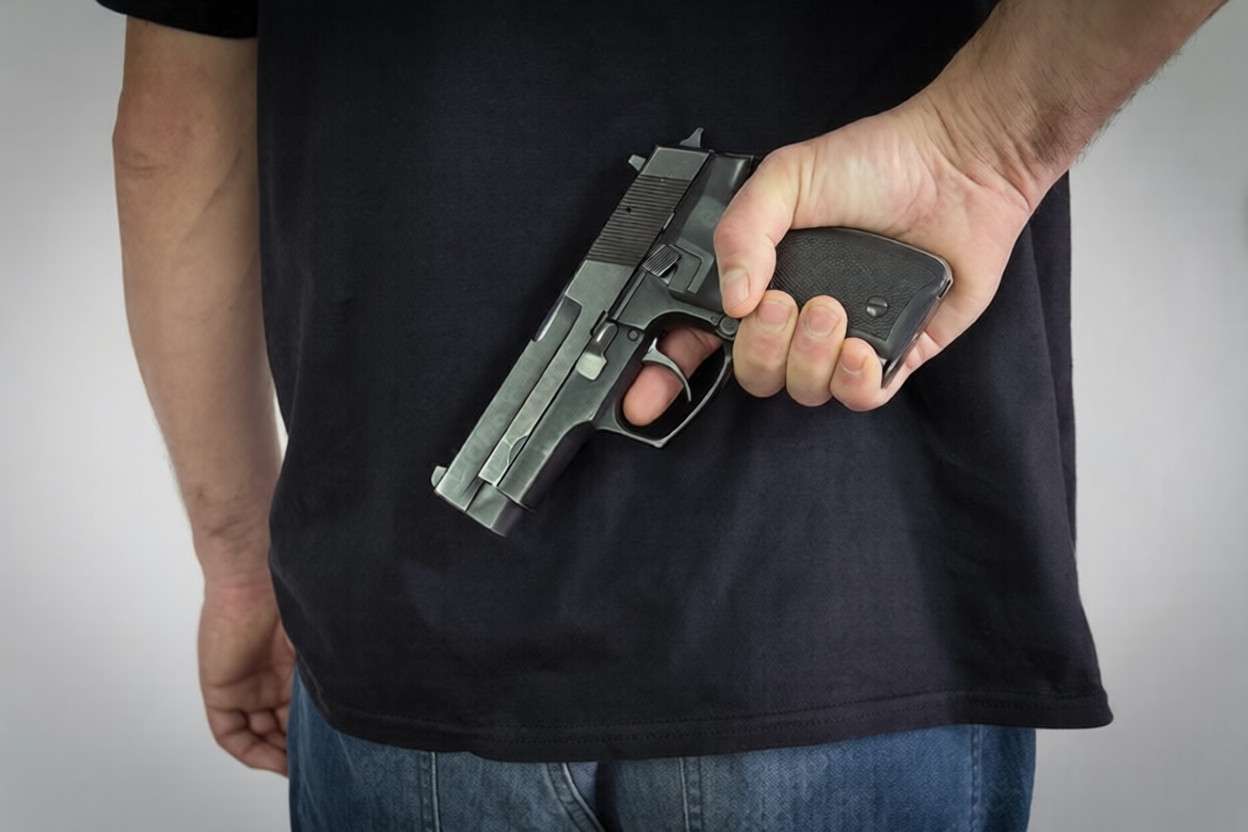
Charged with felon in possession of a firearm in San Bernardino, California? You are facing one of the most aggressively prosecuted weapons offenses in the state — a charge that carries mandatory state prison time, a lifetime ban on owning or possessing firearms, devastating collateral consequences for your career and immigration status, and the permanent weight of a felony conviction on your record.
California Penal Code § 29800 makes it a felony for anyone who has been convicted of a felony to own, purchase, receive, or possess any firearm. The law is sweeping, the penalties are severe, and San Bernardino County prosecutors pursue these cases with intensity. A prior conviction — even one that is years or decades old — can be the basis for a new and serious felony charge the moment law enforcement claims a firearm was found in your presence.
At Tu Defensor Criminalista, Attorney Armando Josué Cespedes provides skilled, aggressive defense representation for clients charged with felon in possession of a firearm throughout San Bernardino County — including San Bernardino, Fontana, Rialto, Ontario, Rancho Cucamonga, Colton, Redlands, Highland, Victorville, Hesperia, Apple Valley, Upland, Montclair, and every surrounding community. We know this charge, we know these courts, and we know how to fight back.
Free Confidential Consultation: (888) 315-3326 | Available 24/7 | Hablamos Español
California Penal Code § 29800 prohibits any person who has been convicted of a felony under California law, federal law, or the law of any other state or country from owning, purchasing, receiving, or possessing any firearm. The prohibition is automatic upon the felony conviction — no court order is required — and it is permanent for the lifetime of the individual.
The law is broad. It covers every type of firearm, including handguns, rifles, shotguns, and any device that meets California’s legal definition of a firearm under Penal Code § 16520.
The prosecution must prove all of the following elements beyond a reasonable doubt:
What Counts as “Possession” Under PC § 29800?
What Does NOT Constitute Possession:
PC § 29800 is not limited to convicted felons. Additional California statutes prohibit firearm possession by other categories of individuals:
Understanding which prohibition applies to your situation — and whether both state and federal charges are possible — is critical to building the right defense strategy.
Felon in possession of a firearm under PC § 29800 is always charged as a felony in California. There is no misdemeanor option — no wobbler status — for this offense. Penalties include:
The base sentence under PC § 29800 is only the beginning. San Bernardino County prosecutors routinely add sentencing enhancements that can multiply the prison term many times over:
PC § 667.5(b) — Prior Prison Term Enhancement: One year added to the sentence for each prior prison term served.
PC § 667(a) — Serious Felony Prior Enhancement: Five years added consecutively for each prior serious felony conviction.
Three Strikes Law (PC §§ 667, 1170.12): If the defendant has prior strike convictions, the sentence for felon in possession may be doubled, and a third strike can result in 25 years to life. According to the California Department of Corrections and Rehabilitation[1], California’s Three Strikes Law has a profound effect on sentences for repeat offenders charged with felony weapons offenses.
Gang Enhancement (PC § 186.22): If the possession was committed to benefit, at the direction of, or in association with a criminal street gang, an additional 2 to 4 years can be added to the sentence for a felony, or the minimum term can be increased dramatically depending on the underlying offense.
Federal Prosecution: If the case is referred to federal court — which happens with some frequency in San Bernardino County — the penalties under 18 U.S.C. § 922(g) include up to 10 years in federal prison. For individuals with prior convictions qualifying under the Armed Career Criminal Act (ACCA), the mandatory minimum jumps to 15 years in federal prison.
A conviction under PC § 29800 reinforces and extends the existing lifetime firearm prohibition. According to the California Department of Justice Bureau of Firearms[2], California operates the Armed Prohibited Persons System (APPS) — a database that actively tracks individuals who are prohibited from possessing firearms and who have firearms registered in their names. Law enforcement uses APPS to proactively investigate and arrest prohibited persons found in possession of firearms.
Any firearms possessed at the time of arrest are seized and forfeited. Upon conviction, any other firearms you have registered or owned must be surrendered or transferred through a licensed dealer to an eligible recipient. Failure to surrender is a new felony under PC § 29810.
San Bernardino County is the largest county by land area in the contiguous United States, stretching from the densely urban Inland Empire to the high desert communities of Victorville, Hesperia, and Apple Valley, and into the vast Mojave Desert. According to the U.S. Census Bureau[3], San Bernardino County has a population of more than 2.1 million people.
According to the California Department of Justice’s OpenJustice data portal[4], weapons violations — including felon in possession arrests — are among the most common felony arrests in San Bernardino County each year. Law enforcement agencies throughout the county, including the San Bernardino County Sheriff’s Department[5], the San Bernardino Police Department[6], the Fontana Police Department, the Ontario Police Department, and others, actively patrol for and investigate weapons possession violations.
The California Department of Justice maintains the Armed Prohibited Persons System (APPS)[7], which California law enforcement uses to identify individuals who are legally prohibited from possessing firearms but who have registered firearms. APPS-driven investigations frequently result in felon in possession arrests throughout San Bernardino County.
According to the Bureau of Alcohol, Tobacco, Firearms and Explosives (ATF)[8], California accounts for tens of thousands of firearms trace requests annually, reflecting the volume of weapons-related investigations conducted by local, state, and federal law enforcement. In San Bernardino County, federal prosecution of felon in possession cases is not uncommon — particularly when the firearm was recently purchased, crosses state lines, or when the defendant has a significant prior record.
The Giffords Law Center to Prevent Gun Violence[9] notes that California’s comprehensive firearms regulatory framework — including universal background checks, the APPS system, and strict possession prohibitions — creates a legal environment where felon in possession charges are among the most actively and successfully prosecuted weapons offenses in the state.
Common Scenarios Leading to Felon in Possession Arrests in San Bernardino:
A conviction under PC § 29800 is a new felony conviction added to your existing record. This means every future employer, landlord, licensing board, or background check will see both the original felony and the new weapons conviction. The compounding effect on your life opportunities is severe.
A felony conviction for felon in possession ends employment possibilities in any profession requiring a firearm, a security clearance, or a background check. According to the California Department of Industrial Relations[10], many professional licenses in California require applicants to disclose felony convictions, and weapons-related felonies frequently result in license denial or revocation across fields including healthcare, real estate, contracting, and transportation.
For non-citizens, a conviction under PC § 29800 is potentially devastating. Firearm offenses are treated as aggravated felonies under federal immigration law, triggering mandatory deportation with virtually no relief available. According to U.S. Citizenship and Immigration Services (USCIS)[11], firearms trafficking and possession offenses are among the most serious categories of criminal conduct for immigration purposes. Even lawful permanent residents with green cards face removal proceedings following a firearm possession conviction. Non-citizen clients must never accept a plea without consulting with our office first about the immigration consequences.
Landlords routinely conduct criminal background checks, and a felony weapons conviction will result in denial of most rental applications. Public housing and Section 8 eligibility is also affected under federal housing regulations, as firearms-related felony convictions can trigger disqualification from federally assisted housing programs. According to the U.S. Department of Housing and Urban Development[12], public housing authorities have broad discretion to deny applicants with felony convictions.
A felony conviction in California results in loss of voting rights while incarcerated and while on parole. Although voting rights are restored upon completion of parole under California law, the period of disenfranchisement — particularly for those facing years in state prison — can span years or decades.
If you are currently on probation or parole, a felon in possession charge automatically constitutes a violation. This means you face not only the new criminal charges but also the reimposition of any suspended sentence from your prior case. Two cases proceeding simultaneously — the new charge and the probation or parole violation — dramatically increases the stakes.
The single most powerful and frequently successful defense in felon in possession cases is a challenge to the search that uncovered the firearm. The Fourth Amendment to the U.S. Constitution protects individuals from unreasonable searches and seizures. If law enforcement discovered the firearm through an unlawful search, we file a motion to suppress the evidence under Penal Code § 1538.5.
Common Fourth Amendment violations in San Bernardino felon in possession cases:
If the search was unlawful, the firearm evidence must be excluded. Without the firearm, there is no case — and the charges must be dismissed.
Result: Evidence suppressed — case dismissed.
PC § 29800 requires that you knew the firearm was in your presence or under your control. This is an essential element the prosecution must prove. If you did not know the firearm was present, you cannot be convicted.
Examples:
Evidence we gather: witness statements about who owns and placed the firearm, forensic evidence including fingerprint analysis and DNA testing, testimony about your lack of access to the location where the firearm was found, and evidence that other individuals in the same space had access and motive to have the firearm.
Result: Prosecution cannot prove knowledge — not guilty.
Even if you knew a firearm existed nearby, the prosecution must prove you possessed it — either actually or constructively. Constructive possession requires that you had dominion and control over the firearm. If the firearm was in a shared space accessible to multiple people and there is no evidence connecting it specifically to you, the prosecution may be unable to meet this burden.
Examples:
Evidence we use: layout of the shared space, access records, other occupants’ criminal histories and connections to the firearm, absence of your fingerprints or DNA on the firearm, and testimony of other residents or occupants.
Result: Cannot prove dominion and control — not guilty.
Not every prior conviction that appears on your record automatically qualifies as a disqualifying felony under PC § 29800. We analyze your prior conviction carefully to determine:
Result: Prior conviction does not qualify — not guilty.
California courts have recognized a narrow defense of temporary, innocent possession. This defense applies when you briefly and momentarily possessed the firearm for the sole purpose of disposing of it or preventing harm, and you had no intent to use it unlawfully.
Elements of the defense:
Example: You find a firearm on the ground, pick it up to prevent a child from accessing it, and are arrested before you can turn it over to police.
Result: Temporary innocent possession recognized — not guilty or charges dismissed.
In cases involving multiple individuals — particularly in traffic stops with multiple occupants or home searches with multiple residents — you may have been misidentified as the person who possessed the firearm. We challenge misidentification through cross-examination of law enforcement witnesses, review of body camera footage, fingerprint and DNA analysis, and alternative suspect investigation.
Result: Misidentification exposed — reasonable doubt — not guilty.
We scrutinize the chain of custody for every piece of physical evidence, including the firearm itself. Breaks in the chain of custody, evidence handling errors, storage failures, or laboratory processing defects can render physical evidence unreliable and subject to exclusion.
Result: Compromised evidence excluded — case significantly weakened or dismissed.
When a firearm is discovered during a probation or parole search, the scope of that search must be carefully analyzed. Probation and parole search conditions authorize searches only within certain defined parameters. A search that exceeds those parameters is unconstitutional, and evidence obtained through an overbroad search can be suppressed.
Result: Evidence from overbroad search suppressed — case dismissed.
In some cases, clients who are arrested for felon in possession may have grounds to pursue post-conviction relief that retroactively restores their firearm rights. Options include:
While these remedies do not undo an arrest that has already occurred, successfully reducing or vacating the prior felony changes the legal landscape of the current PC § 29800 charge entirely.
Result: Prior felony eliminated — PC § 29800 charge no longer legally supportable.
When the facts of the case do not support outright dismissal or acquittal, we negotiate aggressively with the San Bernardino County District Attorney’s Office to resolve the case on terms that minimize consequences. Goals include:
The California Department of Justice maintains the Armed Prohibited Persons System (APPS)[7] — one of the nation’s most sophisticated databases tracking individuals who are prohibited from possessing firearms but who have firearms registered in their names. APPS cross-references the firearm ownership database with records of criminal convictions, domestic violence restraining orders, mental health holds, and other prohibiting events.
When APPS identifies a prohibited person with registered firearms in San Bernardino County, law enforcement is dispatched to confiscate those firearms. This often results in felon in possession arrests — sometimes years after the original conviction — when the prohibited person fails to surrender firearms after their conviction.
If you were notified or visited by law enforcement in connection with an APPS investigation, it is critical that you consult with an attorney immediately before making any statements or allowing any searches.
San Bernardino County is within the jurisdiction of the United States District Court for the Central District of California. Federal prosecutors — the U.S. Attorney’s Office — sometimes choose to prosecute felon in possession cases that originate as state arrests, particularly when:
According to the Federal Bureau of Investigation[13], federal felon in possession prosecutions under 18 U.S.C. § 922(g) carry up to 10 years in federal prison. For individuals with three prior violent felony or serious drug offense convictions under the Armed Career Criminal Act (ACCA), the mandatory minimum sentence is 15 years in federal prison with no parole.
Federal cases require attorneys with experience in both state and federal practice. At Tu Defensor Criminalista, we are prepared to defend clients in both California state court and coordinate with federal defense counsel when federal prosecution is threatened or initiated.
Felon in possession cases are prosecuted as felonies in the San Bernardino County Superior Court system. The primary criminal courthouse serving San Bernardino city is:
San Bernardino Justice Center 247 West Third Street San Bernardino, CA 92415
Additional Superior Court locations throughout the county handle cases from their respective service areas, including courthouses in Rancho Cucamonga, Victorville, and other communities. According to the San Bernardino County Superior Court[14], the court system processes thousands of felony criminal cases annually.
What to Expect in Your Felon in Possession Case:
We have defended numerous clients facing felon in possession charges in San Bernardino County. We know the statutory elements, the most effective defenses, the local enforcement patterns, and the strategies that produce results — from dismissals through suppression motions to favorable negotiated outcomes.
The most powerful defense in felon in possession cases is often a suppression motion. We are skilled at identifying Fourth Amendment violations — unlawful traffic stops, improper vehicle searches, overbroad probation searches, invalid warrants — and presenting those violations persuasively to the court. A successful suppression motion typically ends the case entirely.
We conduct thorough legal analysis of the prior conviction that forms the basis of the PC § 29800 charge. If the prior can be reduced, vacated, or shown not to qualify as a disqualifying felony, the current charge may collapse entirely. This is a defense avenue that less experienced attorneys often overlook.
Felon in possession cases in San Bernardino County can move to federal court. We are prepared to defend clients at both the state and federal levels and understand the critical differences in procedure, evidentiary rules, and sentencing between the two systems.
For non-citizen clients, every decision in a felon in possession case — including whether and how to resolve it — must be evaluated through the lens of immigration consequences. We structure defense strategies and any negotiated resolutions with full awareness of the immigration stakes.
We practice regularly in San Bernardino County Superior Court. Our experience with local prosecutors, judges, and court procedures informs every aspect of how we approach your case.
You work directly with Attorney Armando Josué Cespedes — not a paralegal, not a case manager. Every felon in possession case presents unique facts, and we take the time to understand yours completely before developing your defense strategy.
San Bernardino County’s diverse community includes a large Spanish-speaking population. We provide complete legal representation in both English and Spanish, ensuring clear communication at every stage of your case.
Arrests for felon in possession happen at all hours — during traffic stops, in the early morning during probation searches, or late at night during domestic calls. We are available 24 hours a day, 7 days a week. Contact us immediately after an arrest to protect your rights before you say anything to law enforcement.
Attorney Armando Josué Cespedes holds a perfect 5.0 Avvo rating with 34 five-star client reviews and three consecutive Client’s Choice Awards (2023, 2024, 2025). Our clients consistently praise our responsiveness, thoroughness, and results in reducing or dismissing serious felony charges.
No. The firearm prohibition resulting from a felony conviction is permanent and applies regardless of how long ago the conviction occurred. A felony from 20 or 30 years ago still disqualifies you from possessing any firearm today.
Yes. PC § 29800 covers both actual possession — firearm on your person — and constructive possession — firearm in a location you control, such as your home or vehicle. If prosecutors can show you had dominion and control over the space where the firearm was found, they will charge you.
Lack of knowledge is a valid and complete defense. If you genuinely did not know the firearm was in your vehicle, and we can establish that through evidence, you should not be convicted. The prosecution must prove beyond a reasonable doubt that you knew the firearm was there.
In some cases, yes. If your prior felony is eligible for reduction under Proposition 47 or PC § 17(b), successfully reducing it to a misdemeanor can eliminate the legal basis for the PC § 29800 charge. This analysis depends entirely on the specific prior offense and your eligibility.
Not always. While PC § 29800 is a felony with a prison range of 16 months to 3 years, probation may be available in limited circumstances — particularly for first-time felon in possession offenders without other enhancements. However, if you have prior strikes, gang enhancements, or other aggravating factors, prison becomes far more likely. Effective legal representation significantly affects the outcome.
Not automatically. A warrantless search of your home requires your consent, a valid search warrant, or a specific exception to the warrant requirement. If you are on probation or parole, your search condition may permit searches of your person, vehicle, or residence — but only within the defined scope of that condition. Searches exceeding the scope of the condition are still unconstitutional.
The firearm’s registration to another person in your home does not automatically protect you. If prosecutors can show you had access to and control over the firearm — even if it was registered to a spouse or roommate — they will charge you. However, registration to another person is important evidence supporting a lack of possession defense.
Yes. The Double Jeopardy Clause does not bar separate state and federal prosecutions for the same conduct because they are brought by different sovereigns. Federal felon in possession charges under 18 U.S.C. § 922(g) are separate from California’s PC § 29800 charges and can result in federal prison sentences in addition to — or instead of — state consequences.
A felon in possession charge in San Bernardino is among the most serious weapons offenses you can face — carrying state prison time, a lifetime firearm ban, and devastating consequences for every aspect of your life. Many of these cases are won or significantly reduced through aggressive Fourth Amendment challenges, thorough prior conviction analysis, and skilled courtroom advocacy.
Do not face this charge without experienced defense representation. At Tu Defensor Criminalista, we fight for our clients throughout San Bernardino County — at every stage of the process, from arrest through trial and beyond.
Attorney Armando Josué Cespedes is rated 5.0 on Avvo, with 34 five-star reviews from clients praising his dedication, professionalism, and results. Many note how his trial skills and attention to detail led to reduced charges or outright dismissals.



 English English
 Español de México English English Español de México
Thank you! We need your help. Would you share your experience on one of these sites?
If you have concerns you wish to address privately
