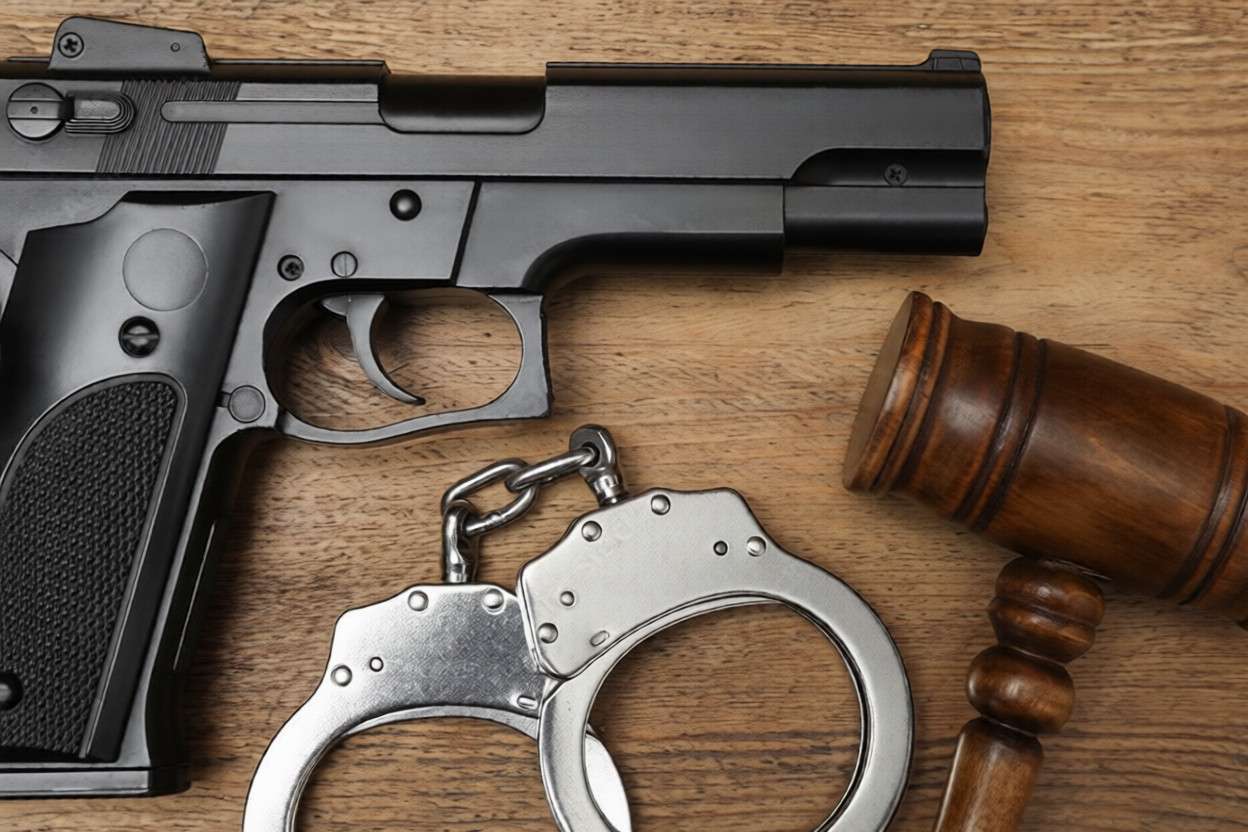
Facing weapons charges in Riverside County, California? You are confronting some of the most serious criminal allegations in the California justice system. Weapons crimes carry mandatory minimum prison sentences, lifetime firearm prohibitions, strikes under California’s Three Strikes Law, devastating professional license consequences, and immigration consequences that can result in permanent deportation. Whether you have been charged with carrying a concealed weapon, possession of a firearm by a felon, assault with a deadly weapon, brandishing a firearm, illegal possession of ammunition, or any other weapons-related offense, your freedom, your rights, and your future are all at stake.
Riverside County law enforcement agencies — including the Riverside County Sheriff’s Department[1], the Riverside Police Department[2], and the California Highway Patrol — treat weapons violations as a top enforcement priority. The Riverside County District Attorney’s Office[3] prosecutes weapons cases aggressively across the county’s diverse communities, from the urban Inland Empire cities of Riverside, Moreno Valley, and Corona to the desert resort communities of Palm Springs and the Coachella Valley. When a weapons charge is filed against you in Riverside County, you need an experienced criminal defense attorney who understands these charges, knows the local court system, and will fight every angle of your case without hesitation.
At Tu Defensor Criminalista, Attorney Armando Josué Cespedes provides skilled, aggressive weapons defense representation for clients throughout Riverside County — including Riverside, Moreno Valley, Corona, Temecula, Murrieta, Hemet, Indio, Palm Springs, Perris, Banning, Beaumont, Lake Elsinore, Menifee, and every surrounding community. We fight to protect your rights, your freedom, and your Second Amendment rights throughout the process.
Free Confidential Consultation: (888) 315-3326 | Available 24/7 | Hablamos Español
California has some of the strictest gun control laws in the nation. According to the Giffords Law Center to Prevent Gun Violence[4], California ranks first in the country for the strength and comprehensiveness of its firearms regulations. The Bureau of Alcohol, Tobacco, Firearms and Explosives (ATF)[5] confirms that California operates under a sweeping regulatory framework governing the purchase, ownership, possession, carrying, and use of firearms that exceeds the requirements of most other states.
This regulatory complexity means that conduct that is perfectly legal in other states — or that seems legal based on common sense — can result in serious felony charges in California. A firearm owner from another state who drives through Riverside County without understanding California’s laws may commit multiple felonies before reaching their destination. A lawful gun owner who forgets a firearm is in their vehicle during a traffic stop may face a concealed weapon charge. Understanding what California’s weapons laws actually prohibit — and building an effective defense when you are charged — requires an attorney with deep expertise in this area of law.
PC § 25400 prohibits carrying a concealed firearm on your person or in a vehicle. A firearm is considered concealed if it is substantially hidden from view of a person who might ordinarily observe it. This charge arises frequently in Riverside County traffic stops along Interstate 15, Interstate 215, Interstate 10, and Highway 91.
This is a wobbler offense:
Misdemeanor Penalties:
Felony Penalties:
Mandatory Felony Circumstances:
PC § 25850 prohibits carrying a loaded firearm on your person or in a vehicle in a public place or on a public street in an incorporated city or prohibited area. This offense frequently arises in Riverside County’s urban communities — Riverside, Moreno Valley, Corona, and others — where carrying a loaded firearm in public without proper authorization is prohibited.
Wobbler offense with penalties mirroring PC § 25400:
PC § 29800 prohibits any person convicted of a felony from owning, purchasing, receiving, or possessing any firearm. This is one of the most commonly and aggressively prosecuted weapons offenses in Riverside County. The California Department of Justice maintains the Armed Prohibited Persons System (APPS)[6] — a database that cross-references firearm registrations with criminal conviction records and actively deploys law enforcement to recover firearms from prohibited persons throughout Riverside County.
Always charged as a felony:
PC § 245(a)(2) makes it a crime to commit an assault using a firearm. The firearm does not need to be discharged — pointing a firearm at someone in a threatening manner is sufficient. This is a serious felony and a qualifying strike offense under California’s Three Strikes Law.
Penalties:
PC § 245(a)(1) applies to assaults committed with any deadly weapon other than a firearm — knives, clubs, bats, vehicles used as weapons, or any object capable of causing death or great bodily injury. This is a wobbler offense.
Penalties:
PC § 246 prohibits maliciously and willfully discharging a firearm at an inhabited dwelling, occupied building, occupied motor vehicle, occupied aircraft, or inhabited housecar or camper. This is one of the most seriously prosecuted weapons offenses due to the extreme danger to public safety.
Serious felony penalties:
PC § 417 prohibits drawing or exhibiting a deadly weapon or firearm in a rude, angry, or threatening manner in the presence of another person, or using such a weapon unlawfully in a fight or quarrel.
PC § 417(a)(1) — Brandishing a Deadly Weapon (Non-Firearm):
PC § 417(a)(2) — Brandishing a Firearm:
PC § 417(b) — Brandishing at a Peace Officer or Firefighter:
PC § 417(c) — Brandishing in a Motor Vehicle:
PC § 30305 makes it illegal for any person prohibited from possessing firearms to own or possess ammunition. This includes convicted felons, individuals convicted of certain misdemeanors, and those subject to domestic violence restraining orders.
Penalties:
PC § 16590 prohibits manufacturing, importing, selling, or possessing certain specifically prohibited weapons including short-barreled shotguns and rifles, zip guns, cane guns, undetectable firearms, multiburst trigger activators, and certain types of knives.
Wobbler penalties:
California’s “10-20-Life” law mandates additional consecutive prison sentences when firearms are used in the commission of certain serious felonies:
These enhancements are added consecutively to the base sentence and can transform a mid-level felony into a sentence measured in decades. They represent one of the most powerful sentencing tools available to Riverside County prosecutors in weapons-related cases.
Riverside County is California’s fourth-largest county by area, spanning from the densely populated Inland Empire cities along the I-215 and I-15 corridors to the resort communities of the Coachella Valley and the rural communities of the San Jacinto Mountains and eastern desert. According to the U.S. Census Bureau[7], Riverside County has a population of more than 2.4 million people — and it is one of the fastest-growing counties in California.
According to the California Department of Justice’s Open Justice data portal[8], weapons violations are consistently among the most commonly prosecuted felony offense categories in Riverside County each year. The FBI’s Uniform Crime Reporting Program[9] tracks weapons offenses nationally, and Riverside County’s combination of urban density, major transportation corridors, and active enforcement programs produces a significant volume of weapons-related arrests and prosecutions annually.
According to the Bureau of Alcohol, Tobacco, Firearms and Explosives (ATF)[5], California generates tens of thousands of firearms trace requests annually, reflecting the volume of weapons investigations conducted by state and local law enforcement. Riverside County agencies — including the Riverside County Sheriff, Riverside Police Department, Corona Police Department, Temecula Police Department, and multiple other municipal agencies — actively investigate and prosecute weapons violations as a public safety priority.
Common Weapons Charge Scenarios in Riverside County:
Under both California and federal law, a felony weapons conviction results in a permanent, lifetime prohibition on owning, purchasing, receiving, or possessing firearms or ammunition. According to the Bureau of Alcohol, Tobacco, Firearms and Explosives[10], federal law prohibits firearm possession by anyone convicted of a crime punishable by more than one year of imprisonment — making virtually every California felony a disqualifying conviction.
For Riverside County residents whose careers, recreational activities, or personal security depend on firearm access — law enforcement officers, security professionals, hunters, competitive shooters, and rural residents — a weapons conviction means permanent loss of this fundamental right.
Multiple weapons offenses qualify as strikes under California’s Three Strikes Law. According to the California Department of Corrections and Rehabilitation[11], a strike doubles the sentence for any subsequent felony conviction and can result in 25 years to life imprisonment for a third strike. The presence of prior strikes dramatically changes the stakes of any weapons charge.
For non-citizens living in Riverside County — a county with a large and diverse immigrant population — weapons convictions are among the most devastating possible criminal outcomes. Firearms offenses are treated as aggravated felonies under federal immigration law, triggering mandatory deportation with virtually no relief available. Even lawful permanent residents with decades of residency face removal proceedings following a felony weapons conviction. According to U.S. Citizenship and Immigration Services (USCIS)[12], firearms trafficking and possession offenses carry the most severe immigration consequences of any criminal category. Non-citizen clients must never accept a plea to a weapons offense without understanding the full immigration consequences.
A weapons conviction threatens professional licenses across every field regulated by California licensing boards. Affected professionals in Riverside County’s diverse economy include:
A felony weapons conviction results in denial of most employment opportunities requiring background checks, loss of positions requiring security clearances, and difficulty obtaining housing in Riverside County’s rental market. According to the U.S. Department of Housing and Urban Development[13], federally subsidized housing eligibility is affected by felony convictions, limiting options for those who need public assistance.
The single most powerful and frequently successful defense in weapons cases is a challenge to the search that uncovered the weapon. If law enforcement discovered the weapon through an unlawful search — of your vehicle, your home, or your person — the weapon evidence must be suppressed under California Penal Code § 1538.5, and the charges must be dismissed.
Common Fourth Amendment violations in Riverside County weapons cases:
Result: Evidence suppressed — case dismissed.
Weapons possession charges require that you knew the weapon was present. If you genuinely did not know the weapon was in the vehicle, home, or other location, the essential knowledge element is absent.
Examples:
Evidence we gather: forensic analysis including fingerprints and DNA, witness testimony about ownership and placement, evidence of other individuals’ access to the location, and documentation of your lack of connection to the weapon.
Result: No knowledge proven — not guilty.
Even where a weapon was present and you were aware of it, the prosecution must prove you possessed it — either actually or constructively. If the weapon was in a shared space accessible to multiple individuals, proving that you specifically had dominion and control may be impossible.
Examples:
Result: Dominion and control not established — not guilty.
California recognizes self-defense and necessity as defenses to certain weapons charges. If you briefly possessed a weapon under circumstances of imminent danger — to protect yourself or another person from an immediate threat — a necessity defense may apply.
Defense elements:
Result: Necessity or self-defense established — not guilty.
For felon in possession charges, the prior conviction that forms the basis of the charge must actually qualify as a disqualifying felony. We analyze the prior conviction to determine:
Result: Prior conviction does not qualify — PC § 29800 charge dismissed.
California law contains specific definitions of what constitutes a firearm, a deadly weapon, or a prohibited weapon. Objects that do not meet these definitions cannot form the basis of the charged offense. We challenge the prosecution’s characterization of the item involved and present expert testimony on the item’s legal classification where necessary.
Result: Item not legally a prohibited weapon — not guilty.
Some weapons charges have exceptions for individuals with valid permits, licenses, or legal authority. Law enforcement officers, licensed security personnel, hunters in appropriate contexts, and others may have legal authority to possess or carry weapons that others cannot. We investigate whether any permit, exemption, or legal authority applies to your situation.
Result: Valid permit or exemption established — charges dismissed.
California courts recognize that briefly and momentarily possessing a firearm for the sole purpose of disposing of it or preventing harm — without any intent to use it unlawfully — may constitute a defense.
Example: You find an abandoned firearm and pick it up to prevent a child from accessing it, intending to turn it over to law enforcement.
Result: Temporary innocent possession recognized — not guilty.
For wobbler weapons offenses — including PC § 25400, PC § 25850, PC § 30305, and brandishing charges under PC § 417(b) and (c) — we fight aggressively to have the charge reduced from a felony to a misdemeanor. A misdemeanor conviction avoids state prison, the permanent felony record, and the most severe professional licensing and immigration consequences.
Factors we present: No prior criminal history, absence of threatening or violent conduct, strong community and family ties, employment history, voluntary surrender of the weapon, and cooperation with law enforcement where appropriate.
Result: Felony reduced to misdemeanor — dramatically reduced consequences.
Even where a weapons conviction is unavoidable, we fight to eliminate or reduce sentencing enhancements — particularly the 10-20-Life enhancement under PC § 12022.53 and gang enhancements under PC § 186.22. Successful challenges to enhancements can mean the difference between years and decades in state prison.
Result: Enhancements stricken or reduced — significantly shorter sentence.
Riverside County’s gang enforcement programs — operated by the Riverside County Sheriff’s Department, Riverside Police Department, and other agencies — frequently combine weapons charges with gang enhancement allegations under PC § 186.22. When a gang enhancement is added to a weapons charge, the consequences escalate dramatically:
According to the California Department of Justice[14], gang-related offenses are a significant component of weapons prosecutions in Riverside County. We challenge gang enhancement allegations by attacking the evidence of gang membership, contesting the connection between the weapons offense and gang activity, and challenging expert gang testimony.
Weapons cases in Riverside County are prosecuted through the Riverside County Superior Court system. Key courthouse locations include:
Riverside Hall of Justice 4100 Main Street Riverside, CA 92501
Southwest Justice Center (Temecula/Murrieta) 30755 Auld Road Murrieta, CA 92563
Banning Justice Center (Eastern Riverside County) 311 East Ramsey Street Banning, CA 92220
Indio Court (Coachella Valley) 46200 Oasis Street Indio, CA 92201
Hemet Court 880 North State Street Hemet, CA 92543
According to the Riverside County Superior Court[15], the court system processes thousands of felony and misdemeanor criminal cases annually across its multiple courthouse locations, with weapons offenses representing a significant and consistently prosecuted category.
The most powerful weapons defense is often a suppression motion. We are skilled at identifying constitutional violations in traffic stops, vehicle searches, home searches, and probation or parole searches — and presenting those violations persuasively to Riverside County Superior Court judges. A successful suppression motion typically ends the case.
For felon in possession cases, we conduct thorough legal analysis of the prior conviction underlying the charge. If the prior can be reduced, vacated, or shown not to qualify, the current charge collapses. This is a defense avenue that makes the difference between a felony conviction and freedom.
Riverside County prosecutors frequently add gang enhancements to weapons charges. We challenge these enhancements aggressively — attacking the evidence of gang membership, the connection to gang activity, and the reliability of gang expert testimony.
Some Riverside County weapons cases — particularly those involving firearms trafficking, recently purchased weapons, or defendants with extensive prior records — may be subject to federal prosecution under 18 U.S.C. § 922(g). We are aware of federal prosecution patterns in the Central District of California and prepare our clients for this possibility.
Riverside County has a large and diverse immigrant population. For non-citizen clients, every decision in a weapons case must be evaluated through the lens of immigration law. We structure defense strategies and any negotiated resolutions with full awareness of the immigration consequences of every potential outcome.
We practice across all Riverside County Superior Court locations — from the Hall of Justice in Riverside to the Southwest Justice Center in Murrieta to the Indio Court serving the Coachella Valley. Our experience at each courthouse informs our approach to every weapons case.
We provide complete legal representation in both English and Spanish, serving Riverside County’s large Spanish-speaking community with clear communication and thorough advocacy at every stage.
Weapons arrests happen at any hour. We are available 24 hours a day, 7 days a week to respond immediately when you or a family member needs help.
Attorney Armando Josué Cespedes holds a perfect 5.0 Avvo rating with 34 five-star client reviews and three consecutive Client’s Choice Awards (2023, 2024, 2025). Our clients consistently praise our expertise, responsiveness, and results in serious felony cases.
Yes. Even lawful gun owners can face charges for carrying a concealed weapon without a permit, carrying a loaded firearm in public, brandishing, or possessing a firearm in a prohibited location. Ownership rights and carrying or possession rights are separate under California law.
Possibly. If the traffic stop lacked reasonable suspicion, or if the vehicle search was conducted without consent, a warrant, or a valid legal exception, we can file a motion to suppress. A successful suppression motion typically results in case dismissal.
Yes. The firearm prohibition resulting from a felony conviction is permanent regardless of how long ago the conviction occurred. However, if the prior felony was a wobbler that was reduced to a misdemeanor, or if it qualifies for Proposition 47 reduction, the PC § 29800 charge may not apply.
PC § 12022.53 adds mandatory consecutive prison time — 10 years for using a firearm, 20 years for discharging it, and 25 years to life for causing injury or death — on top of the sentence for the underlying felony. These enhancements can dramatically increase total prison exposure and must be challenged aggressively.
For wobbler offenses — including carrying a concealed weapon, carrying a loaded firearm, possession of ammunition by a prohibited person, and some brandishing charges — yes. We fight aggressively to have felony charges filed or reduced as misdemeanors whenever legally possible.
Extremely serious. Firearms offenses are treated as aggravated felonies under federal immigration law, triggering mandatory deportation with virtually no relief available — even for long-term lawful permanent residents. Non-citizens must never accept a plea to a weapons offense without understanding the full immigration consequences.
Lack of knowledge is a valid and complete defense. If you genuinely did not know the weapon was in your vehicle, and we can establish that through evidence, you should not be convicted. We gather forensic evidence, witness testimony, and other documentation to support this defense.
It is very difficult but not impossible in some circumstances. Options may include obtaining a Governor’s Pardon, pursuing a Certificate of Rehabilitation, or reducing a wobbler felony to a misdemeanor under PC § 17(b). The availability of these options depends entirely on the specific conviction and your eligibility.
A weapons charge in Riverside County is among the most serious criminal matters you can face — carrying mandatory prison time, lifetime firearm prohibitions, Three Strikes implications, and consequences for every aspect of your life. The quality and aggressiveness of your defense attorney is the single most important factor in the outcome of your case.
At Tu Defensor Criminalista, we fight for clients throughout Riverside County at every stage of the process — from arrest through trial and beyond. Contact us today for a free, confidential consultation and let us start building your defense immediately.
Attorney Armando Josué Cespedes is rated 5.0 on Avvo, with 34 five-star reviews from clients praising his dedication, professionalism, and results. Many note how his trial skills and attention to detail led to reduced charges or outright dismissals.



 English English
 Español de México English English Español de México
Thank you! We need your help. Would you share your experience on one of these sites?
If you have concerns you wish to address privately
