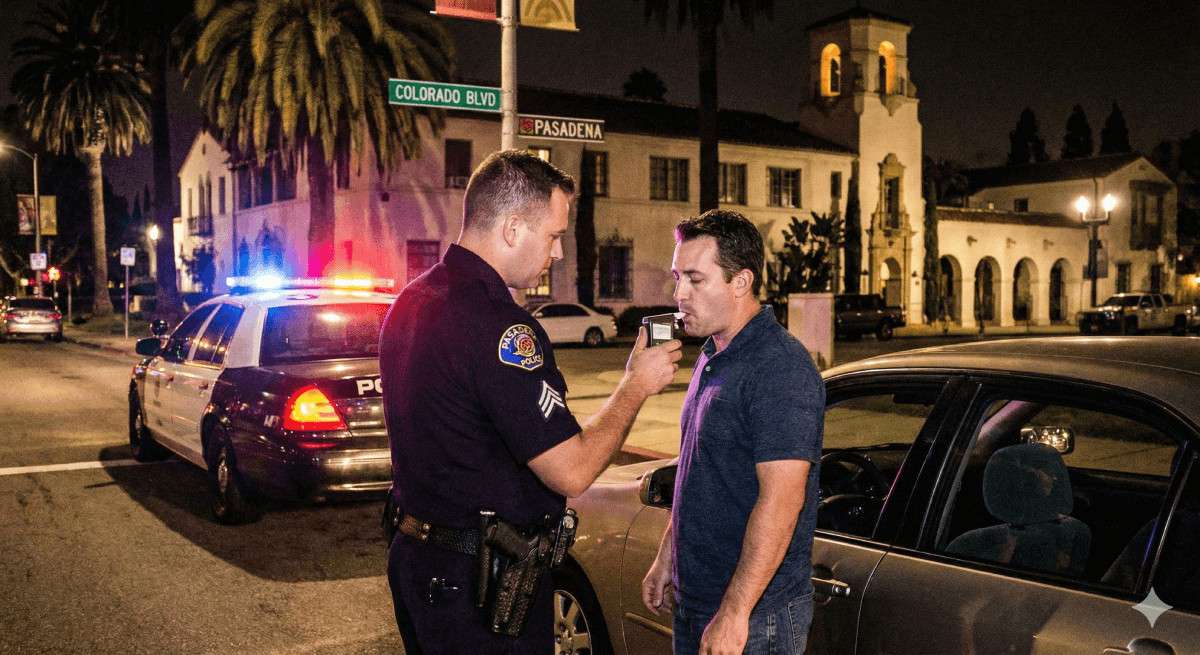
Arrested for DUI in Pasadena? You’re facing serious criminal charges under California Vehicle Code Section 23152 that carry harsh penalties including jail time, substantial fines, license suspension, mandatory DUI programs, and a permanent criminal record. Even though most DUI offenses are charged as misdemeanors rather than felonies, the consequences are still severe and can impact your employment, professional licenses, insurance rates, and future for years to come.
The Pasadena Police Department investigated 225 DUI cases in 2024, up from 194 in 2023[1], representing a 16% increase in DUI enforcement activity. With 83 DUI-related collisions[1] occurring in the city and aggressive checkpoint operations conducted regularly, Pasadena law enforcement maintains a strong focus on DUI arrests. Drivers charged with a first-time DUI face an average of $13,500 in fines and penalties[2], as well as a suspended license.
At Tu Defensor Criminalista, we provide aggressive, experienced misdemeanor DUI defense to clients throughout Pasadena and surrounding Los Angeles County communities. We understand California DUI law inside and out, know the Pasadena court system, and fight tirelessly to protect your rights, your license, and your future.
Free Confidential Consultation: (888) 315-3326 | Available 24/7 | Hablamos Español
California law defines DUI under two separate but related statutes, and most DUI arrests result in charges under both sections:
Vehicle Code 23152(a) – Driving Under the Influence: This statute makes it illegal to operate a vehicle while under the influence of alcohol or drugs, regardless of your blood alcohol concentration (BAC). You can be convicted under this section even if your BAC is below 0.08% if the prosecution proves that alcohol or drugs impaired your physical or mental abilities to the extent that you could no longer drive as safely as a cautious, sober person would under similar circumstances.
Under this law, prosecutors rely on circumstantial evidence to prove impairment including driving patterns (weaving, speeding, erratic driving), physical symptoms observed by police (odor of alcohol, slurred speech, bloodshot eyes, unsteady gait), field sobriety test performance, and statements you made to officers. The subjective nature of these observations creates significant opportunities for effective legal defense.
This statute makes it automatically illegal to drive with a BAC of 0.08% or higher. The term “per se” means that the law considers you guilty by the mere fact of having this BAC level, regardless of whether you actually appeared impaired. If chemical testing shows a BAC at or above 0.08%, prosecutors can pursue charges under this section based solely on the test results.
According to California DMV statistics, the median BAC among convicted DUI offenders is 0.16%[3]—double the legal limit—indicating that many drivers arrested for DUI have significantly elevated alcohol levels.
When arrested for DUI in Pasadena, you will typically face charges under both sections. However, even if convicted of both, it counts as only one DUI conviction for sentencing and prior offense purposes.
To convict you of misdemeanor DUI, Pasadena prosecutors must prove beyond a reasonable doubt:
For Vehicle Code 23152(a):
For Vehicle Code 23152(b):
The “driving” element requires actual vehicle operation or control. If police never witnessed you driving and cannot prove you were the driver, the prosecution’s case fails. The impairment or BAC element must exist at the time of driving, not hours later when testing occurred—this creates the “rising blood alcohol” defense discussed later.
Most DUI offenses in California are misdemeanors, but prosecutors escalate charges to felony DUI when:
California’s DUI laws are “priorable,” meaning each conviction within a 10-year period results in progressively harsher penalties. According to statewide data,among convicted DUI offenders arrested in 2019, 72.8% were first offenders and 27.2% were repeat offenders[3]. The percentage of repeat offenders has decreased significantly from 37% in 1989 to 26% in 2012, largely due to increased enforcement and deterrent effects of harsh penalties.
A first-time misdemeanor DUI conviction in California carries the following potential penalties:
Jail Time: Up to six months in county jail. However, many first-time offenders receive no actual jail time or receive sentences measured in days rather than months, especially with strong legal representation. Among first DUI offenders arrested in 2019, 66.3% were sentenced to jail[3], but actual custody time served is often minimal.
Probation: Summary (informal) probation for three to five years is the most frequently imposed court penalty, given in 95.9% of all convicted DUI cases[3]. Probation conditions typically include:
Fines and Fees: Base fines range from $390 to $1,000, but California adds multiple penalty assessments that can triple or quadruple the total. With all assessments, court costs, and program fees included, first-time DUI offenders face total costs averaging $13,500 to $20,000[1].
DUI Education Program: First offenders with BAC below 0.20% must complete a three-month (30-hour) DUI program. Those with BAC of 0.20% or higher must complete a nine-month (60-hour) program. Programs cost approximately $500-$800 for the three-month program and $800-$1,200 for longer programs.
License Suspension: The California DMV imposes a six-month license suspension for first-time DUI convictions under Vehicle Code 13352(a)(1). However, you can usually obtain a restricted license with an ignition interlock device (IID) that allows you to drive anywhere, anytime with the device installed. Only 15.9% of DUI offenders received ignition interlock requirements[3] historically, but California’s current laws now mandate IID for all DUI convictions.
A second misdemeanor DUI conviction within 10 years of the first carries enhanced penalties:
A third misdemeanor DUI within 10 years results in the harshest misdemeanor-level penalties:
Separate from criminal court penalties, the California DMV automatically suspends licenses through its Administrative Per Se program:
First Offense: Four-month suspension Second Offense: One-year suspension Third Offense: One-year suspension
According to California DMV data, in 2020, 91,300 APS license actions were taken, with 72.1% being first-offender actions and 27.9% repeat-offender actions[3]. You have only 10 days from your arrest date to request a DMV hearing to contest this suspension. If you don’t request a hearing, the suspension automatically takes effect 30 days after arrest.
The DMV and criminal court proceedings are completely separate. You can win one and lose the other, though an acquittal in criminal court can result in reversal of the DMV suspension.
Pasadena maintains aggressive DUI enforcement through multiple strategies:
DUI enforcement in Pasadena receives funding from the California Office of Traffic Safety through the National Highway Traffic Safety Administration[2], enabling regular checkpoint and saturation patrol operations. This federal and state funding allows Pasadena to maintain year-round DUI enforcement beyond what municipal budgets alone would support.
DUI arrests in Pasadena are prosecuted at the Pasadena Superior Courthouse located at 300 East Walnut Street, Pasadena, CA 91101. The courthouse serves the Northeast Judicial District, handling both misdemeanor and felony cases for Pasadena, Altadena, Sierra Madre, San Marino, and surrounding communities.
Courthouse Information:
Los Angeles County Deputy District Attorneys from the Pasadena branch office handle all DUI prosecutions. These prosecutors are experienced in DUI cases and pursue penalties aggressively, making skilled legal defense essential.
The Fourth Amendment protects you from unreasonable searches and seizures. Police must have reasonable suspicion of criminal activity or a traffic violation before stopping your vehicle. Common challenges include:
Lack of Reasonable Suspicion: Officers must observe specific, articulable facts suggesting criminal activity or Vehicle Code violations. Vague hunches, anonymous tips without corroboration, or stops based solely on time of day or location violate your constitutional rights. If the stop was unlawful, all evidence obtained afterward—including field sobriety tests and chemical tests—must be suppressed under the exclusionary rule.
Pretextual Stops: Police cannot use minor traffic violations as pretexts to investigate suspected DUI without genuine probable cause for the stop.
DUI Checkpoint Violations: While generally constitutional, DUI checkpoints must follow strict guidelines established by the California Supreme Court in Ingersoll v. Palmer:
Checkpoints that violate these requirements provide grounds for suppressing all evidence obtained.
Field sobriety tests (FSTs) are notoriously unreliable indicators of intoxication:
Standardized Field Sobriety Tests (SFSTs): The National Highway Traffic Safety Administration recognizes only three validated tests:
Even under ideal conditions with perfect administration, these tests produce false positives. Factors affecting performance include:
Improper Administration: Officers must be properly trained in NHTSA protocols and must administer tests according to standardized procedures. Deviations from protocols invalidate results. Many officers receive minimal training and make procedural errors that render test results unreliable.
Voluntary Nature: Field sobriety tests are completely voluntary in California. You cannot be punished for refusing, though officers may cite refusal as evidence of consciousness of guilt. However, polite refusal eliminates this unreliable evidence from the prosecution’s case.
Blood and breath testing is imperfect science subject to numerous sources of error:
Rising Blood Alcohol Defense: Alcohol takes 30 minutes to three hours to fully absorb into your bloodstream after consumption. Your BAC may have been below 0.08% while driving but rose above the legal limit by the time of testing, especially if significant time elapsed between driving and testing. This defense is particularly effective when arrests occur shortly after you stopped drinking.
Mouth Alcohol Contamination: Breathalyzers measure alcohol in your breath, not your blood. Residual mouth alcohol from recently consumed beverages, GERD (gastroesophageal reflux disease), dental work, or regurgitation can artificially inflate breath test results significantly.
Title 17 Violations: California Code of Regulations Title 17 establishes mandatory protocols for DUI testing. Violations that invalidate test results include:
Medical Conditions: Certain medical conditions produce false positive test results or mimic intoxication:
Blood Test Fermentation: Blood samples that are not properly preserved with sodium fluoride can ferment, producing alcohol that wasn’t present when blood was drawn. This is especially problematic when samples are not refrigerated or when testing is delayed.
Even if chemical tests show elevated BAC, several defenses may apply:
If police didn’t witness you driving, the prosecution must prove you were the driver through circumstantial evidence. Situations where the driving element is contestable include:
Without proof beyond a reasonable doubt that you were driving, the prosecution’s case fails entirely.
California recognizes necessity as an affirmative defense when you drove while impaired to prevent greater harm:
These defenses require showing that you faced genuine, immediate danger that left no time for legal alternatives like calling 911 or taking a taxi.
Law enforcement must follow proper arrest procedures:
Understanding the DUI arrest process helps you protect your rights:
After a Pasadena DUI arrest, several critical deadlines apply:
DMV Hearing Request (10 Days): You have only 10 days from arrest to request a DMV administrative hearing to contest your license suspension. Missing this deadline results in automatic suspension without opportunity for review. Requesting a hearing also stays (temporarily halts) the suspension until the hearing is resolved.
Arraignment: Your first court appearance, typically scheduled within several weeks of arrest (48 hours if in custody). At arraignment:
Having an attorney at arraignment can result in reduced bail, favorable release conditions, and immediate investigation of your case.
Discovery and Motion Deadlines: Various deadlines apply for filing motions, requesting discovery, and challenging evidence. Your attorney will ensure all deadlines are met.
The DMV hearing is separate from criminal court and focuses solely on your driving privileges. At the hearing, the DMV hearing officer determines whether:
You have the right to:
Winning your DMV hearing preserves your driving privileges even if criminal charges proceed. Approximately 20.5% of DUI arrests in 2019 showed no corresponding conviction on DMV records[3], indicating that many DUI arrests do not result in convictions.
Effective DUI defense in Pasadena requires:
Beyond court-imposed penalties, DUI convictions create lasting consequences:
In appropriate cases, DUI charges can be reduced to “wet reckless” under Vehicle Code 23103.5. A wet reckless is reckless driving involving alcohol that:
Advantages:
Disadvantages:
Wet reckless pleas are most common when:
In rare cases with significant legal problems in the prosecution’s case, charges may be reduced to “dry reckless” under Vehicle Code 23103 (reckless driving without alcohol). This resolution:
Dry reckless pleas typically require substantial weaknesses in the prosecution’s evidence or constitutional violations.
Some jurisdictions offer DUI diversion programs, though these are not available in all Los Angeles County courts. Diversion typically requires:
Upon successful completion, charges are dismissed entirely. However, diversion programs are generally limited to first-time offenders with no aggravating factors.
Understanding statewide DUI statistics provides important context:
Penalties Imposed: Court penalties for convicted DUI offenders include:
Pasadena’s DUI enforcement reflects local priorities:
Investigation Volume: Pasadena Police investigated 225 DUI cases in 2024, compared to 194 in 2023[1], representing a 16% year-over-year increase.
DUI Collisions: The city experienced 83 DUI-related collisions[1] during this period, some causing serious injuries.
Checkpoint Effectiveness: Recent checkpoint operations demonstrate Pasadena’s commitment to DUI enforcement, with checkpoints resulting in multiple arrests for DUI and related offenses[5].
Field sobriety tests are voluntary and you can politely decline without penalty. These tests are designed to gather evidence against you and are subjective evaluations that even sober people often fail. Refusing eliminates this unreliable evidence from the prosecution’s case. However, you should always be polite and respectful when declining.
The DMV administrative hearing is a civil proceeding concerning only your driving privileges. The criminal court case addresses criminal penalties including jail, fines, and probation. These are completely separate proceedings with different standards of proof and different outcomes. You can win one and lose the other. Having an attorney represent you at both proceedings maximizes your chances of favorable outcomes.
First-time DUI convictions result in six-month court-ordered suspensions and four-month administrative (DMV) suspensions. However, these suspensions typically run concurrently, and you can usually obtain an ignition interlock device (IID) restricted license that allows you to drive anywhere, anytime with the IID installed. You have only 10 days from arrest to request a DMV hearing to contest the administrative suspension.
Yes. Approximately 20.5% of DUI arrests result in no conviction, and many others result in reduced charges like wet reckless or dry reckless. Outcomes depend on the specific facts of your case, the strength of the prosecution’s evidence, legal defenses available, and the quality of your legal representation. Common grounds for dismissals include illegal stops, improper testing procedures, inaccurate BAC results, and constitutional violations.
Whether you lose your job depends on your employer’s policies and your job requirements. Many private employers do not terminate employees for first-time misdemeanor DUI convictions, especially if you disclose proactively and maintain employment during the case. However, certain professions require reporting DUI arrests to licensing boards, and some licenses face suspension or revocation. Commercial driver’s license (CDL) holders face particularly severe consequences. Consulting with an attorney early helps you understand your specific employment risks.
High BAC levels (0.15% or above) result in enhanced penalties including longer DUI programs and potentially longer license suspensions. However, very high BAC readings also create defense opportunities. Extremely high readings suggest potential testing errors, mouth alcohol contamination, or improper calibration. An experienced DUI attorney can challenge the accuracy of high BAC results.
Many first-time DUI defendants avoid jail time entirely or receive minimal custody time through alternative sentencing like community service, work release, or house arrest. While jail is a possibility for first offenses, skilled legal representation and strong mitigation can often result in no actual jail time, especially when no accident or injury occurred.
DUI convictions typically result in substantial insurance rate increases of 50-100% or more, costing thousands of dollars over three years. You’ll also be required to file SR-22 proof of insurance. Some insurers cancel policies entirely after DUI convictions, forcing you to seek high-risk insurance at significantly higher rates. These financial consequences make fighting DUI charges worthwhile.
An IID is a breathalyzer installed in your vehicle that prevents the engine from starting unless you provide a clean breath sample showing no alcohol. California now requires IID installation for all DUI convictions. Devices cost $70-$150 to install plus $60-$80 monthly monitoring fees. While inconvenient, IIDs allow you to continue driving during license suspension periods.
Absolutely. DUI cases involve complex legal issues, scientific evidence, and constitutional protections that require specialized knowledge. The average total cost of a first-time DUI conviction is $13,500 to $20,000, and the consequences extend far beyond financial costs. An experienced DUI attorney can often save you much more than the attorney fees through reduced charges, dismissed cases, or minimized penalties. Additionally, attorneys understand local court procedures, have relationships with prosecutors, and know how to challenge flawed evidence effectively.
If you’ve been arrested for misdemeanor DUI in Pasadena, time is critical. You have only 10 days to request a DMV hearing to save your license, and early legal intervention dramatically improves your chances of favorable outcomes. Don’t face these serious charges alone.
Tu Defensor Criminalista provides experienced, aggressive misdemeanor DUI defense throughout Pasadena and Los Angeles County. We offer:
Contact Information:
Available: 24 Hours a Day | 7 Days a Week
Languages: English & Spanish (Hablamos Español)
We proudly serve clients throughout Pasadena and surrounding Los Angeles County communities including:
We handle cases at Pasadena Superior Courthouse and throughout Los Angeles County’s court system.
In addition to misdemeanor DUI defense, we handle:
We serve clients throughout Los Angeles County, San Bernardino County, Riverside County, Orange County, San Diego County, Imperial County, Ventura County, San Luis Obispo County, Santa Barbara County, Fresno County, Kern County, Inyo County, Kings County, Tulare County, Marin County, San Mateo County, San Joaquin County, Alameda County, and Monterey County.
Don’t let a misdemeanor DUI arrest destroy your future. The consequences are too serious to handle alone. Call Tu Defensor Criminalista now at (888) 315-3326 for the experienced, aggressive legal defense you deserve.
Attorney Armando Josué Cespedes is rated 5.0 on Avvo, with 34 five-star reviews from clients praising his dedication, professionalism, and results. Many note how his trial skills and attention to detail led to reduced charges or outright dismissals.



 English English
 Español de México English English Español de México
Thank you! We need your help. Would you share your experience on one of these sites?
If you have concerns you wish to address privately
